The Work Programme priority: clearing deployment bottlenecks
The Commission will soon publish its annual Work Programme. Work Programmes remain stubbornly measured against how many new initiatives are announced, withdrawn or “simplified” (and how quickly). This feels very much like confusing outcomes with outputs.
It is also, directionally, wrong. Europe has spent recent years identifying “must-win” technologies like quantum, biotech, cleantech, space etc. The Work Programme should focus on what is still preventing these promising technologies from reaching the market.
***
Go to any deep tech policy conference, and you will hear “Europe is great at research, but poor at deploying it as innovation.” At first, this can come across as filler - a politically uncontroversial statement to make to a room full of founders and investors. But if you look at the data, it is a top-tier concern for communities in exactly the policy areas the EU must, by its own admission, win.
Commission Calls for Evidence are public consultations. They are launched before new policy initiatives for stakeholders to raise their views. There have been several Calls in recent years on the technologies I mentioned above. We trained a model to identify and cluster policy themes raised in stakeholder responses to these Calls. The results - we believe - are a much more complete, unbiased picture of what the community is calling for than human brainpower alone could have painted. (1)
With the exception of the EU Space Act (which only attracted 25 responses, so we discarded it), deployment of innovation, in one form or another, did indeed emerge as a dominant issue across all consultations - even when respondents didn’t mention the term “deployment” directly. (2)
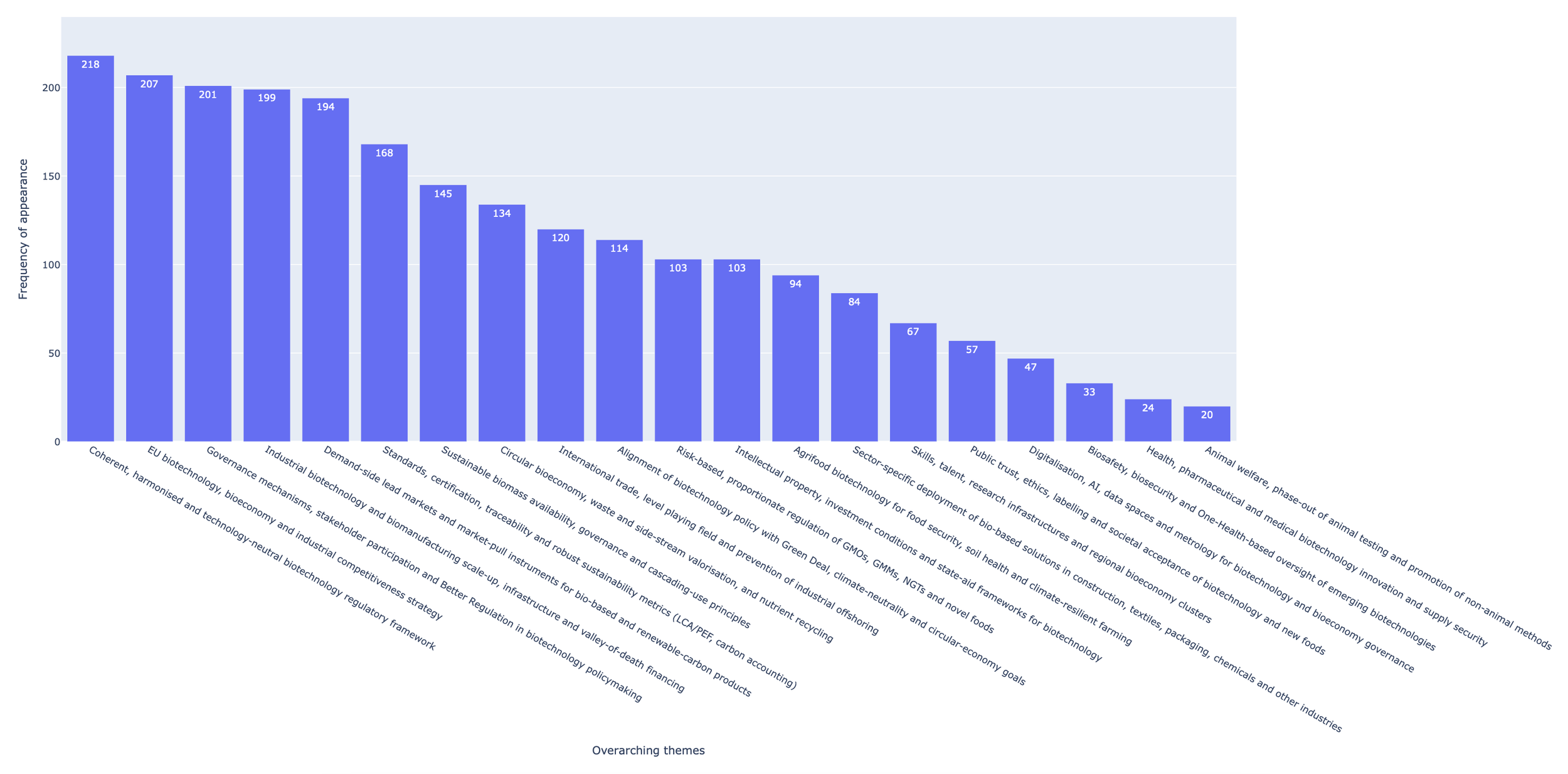
In biotech, deployment emerged in the form of “industrial biotechnology, biomanufacturing scale-up, infrastructure and valley-of-death financing”:
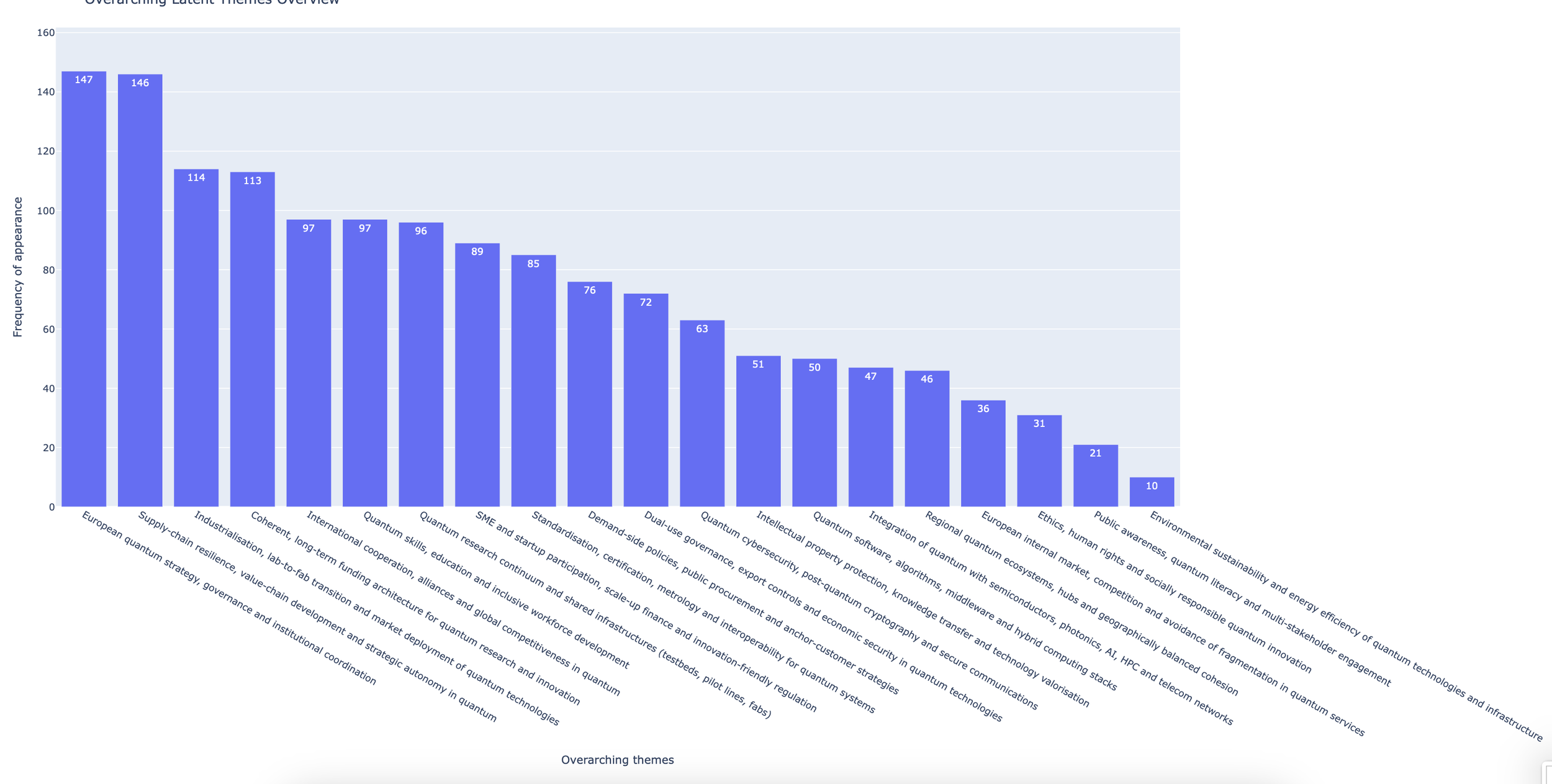
In quantum, it appeared as “industrialisation, lab-to-fab transition and market deployment of quantum technologies”:
In the cleantech industry we examined, stakeholders emphasised broader industrial ecosystem issues:
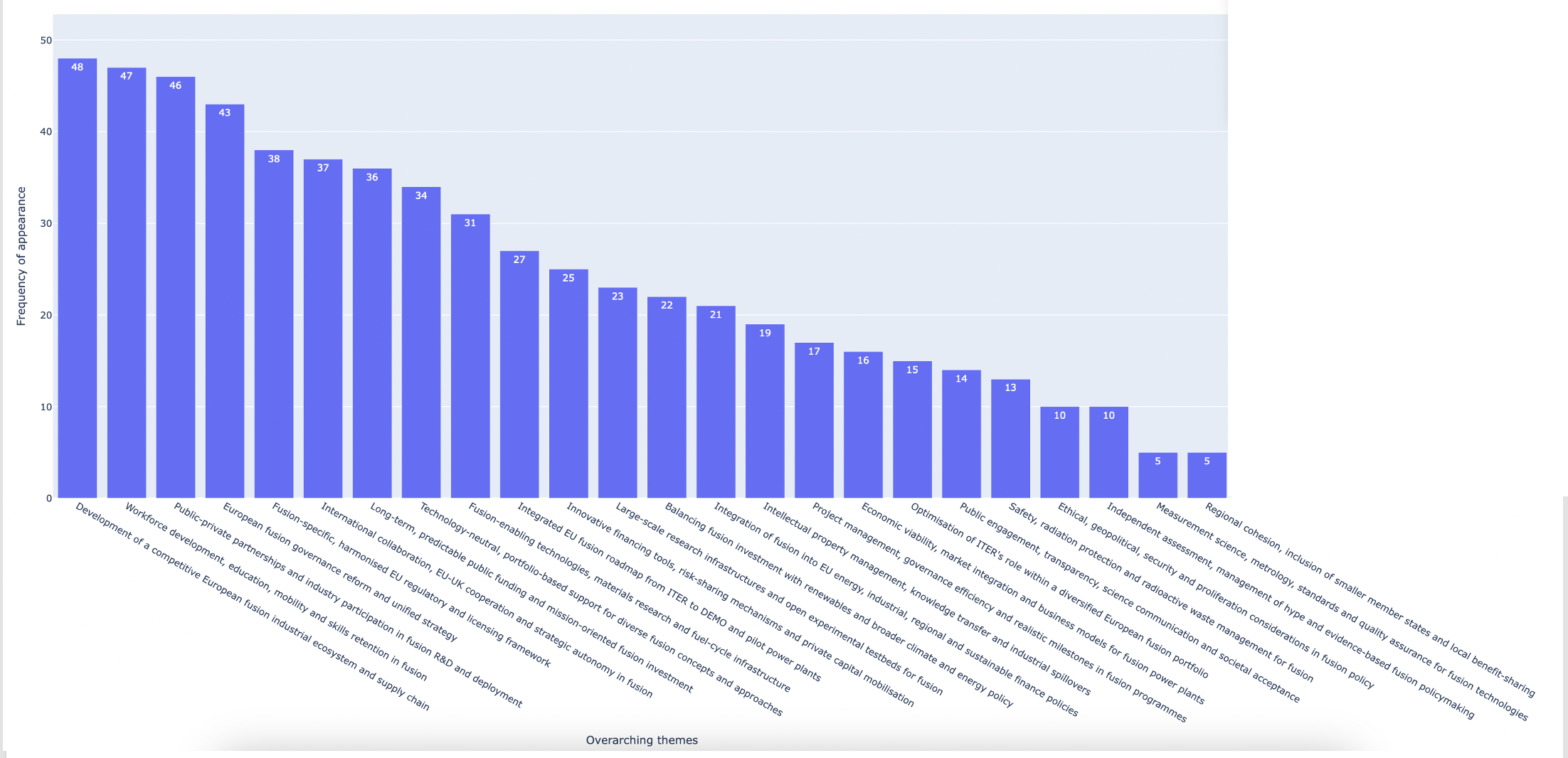
Getting technologies out of the lab and onto the market emerged as a challenge in all ecosystems, even if expressed differently (3)
***
But more interesting than what was raised is who raised deployment. There is a classic, perhaps false, dichotomy that Europe’s research community always pushes for more focus on research, while industry always tries to nudge attention towards commercialisation. We wanted to test whether this holds.
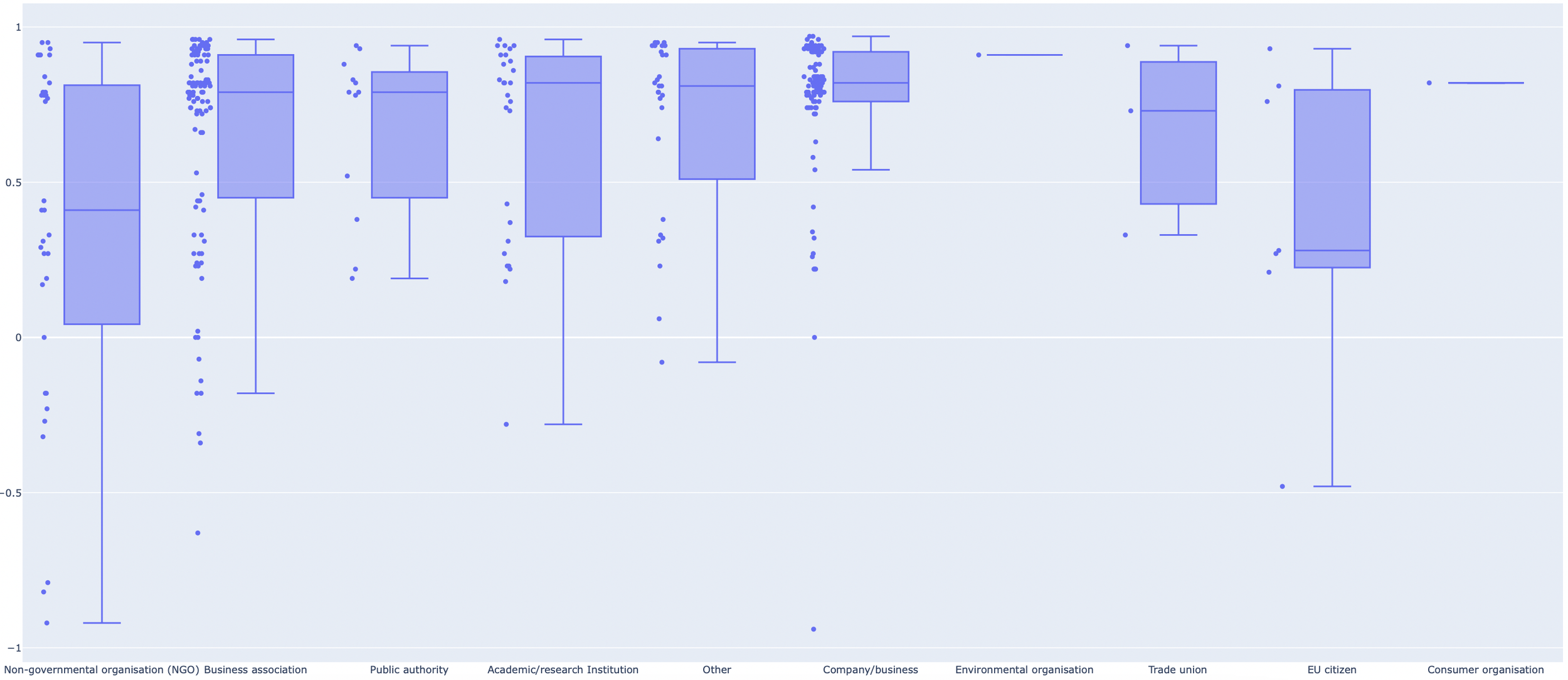
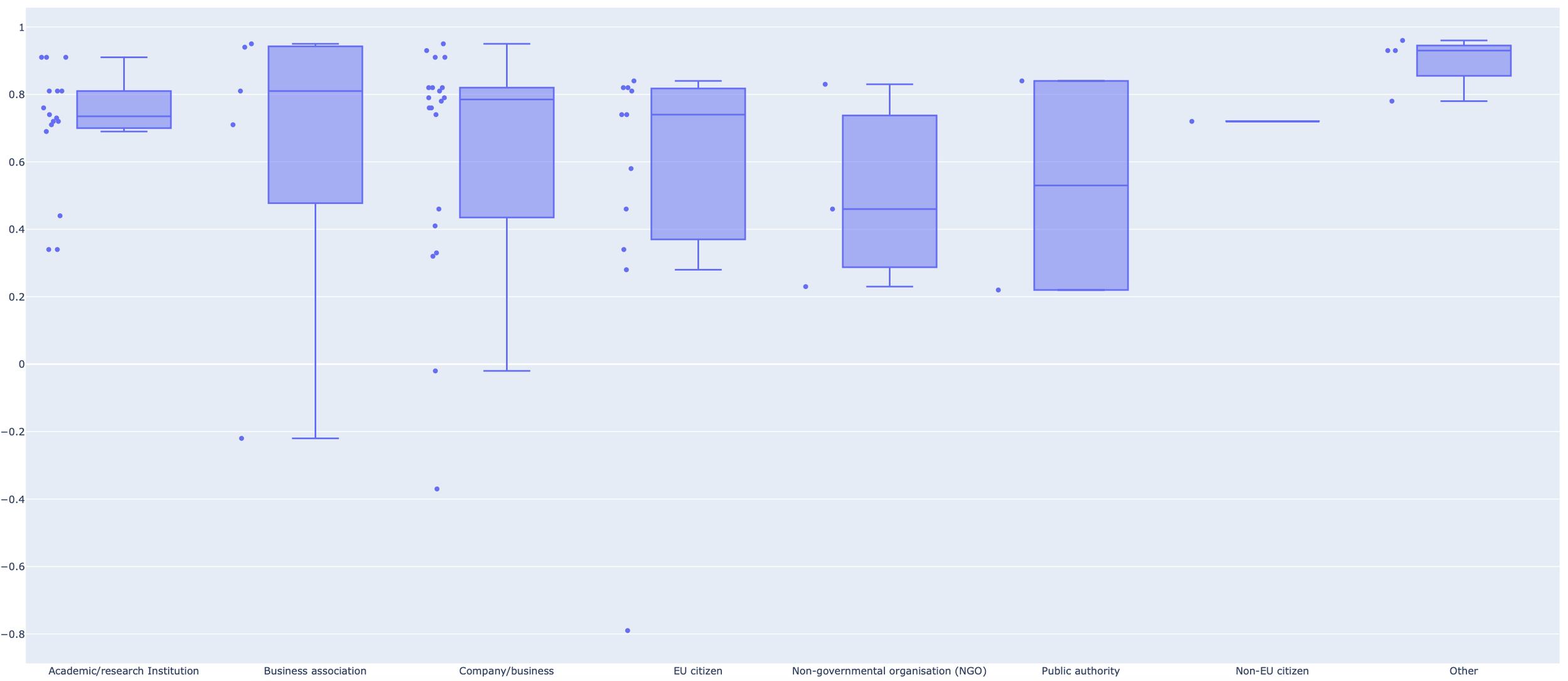
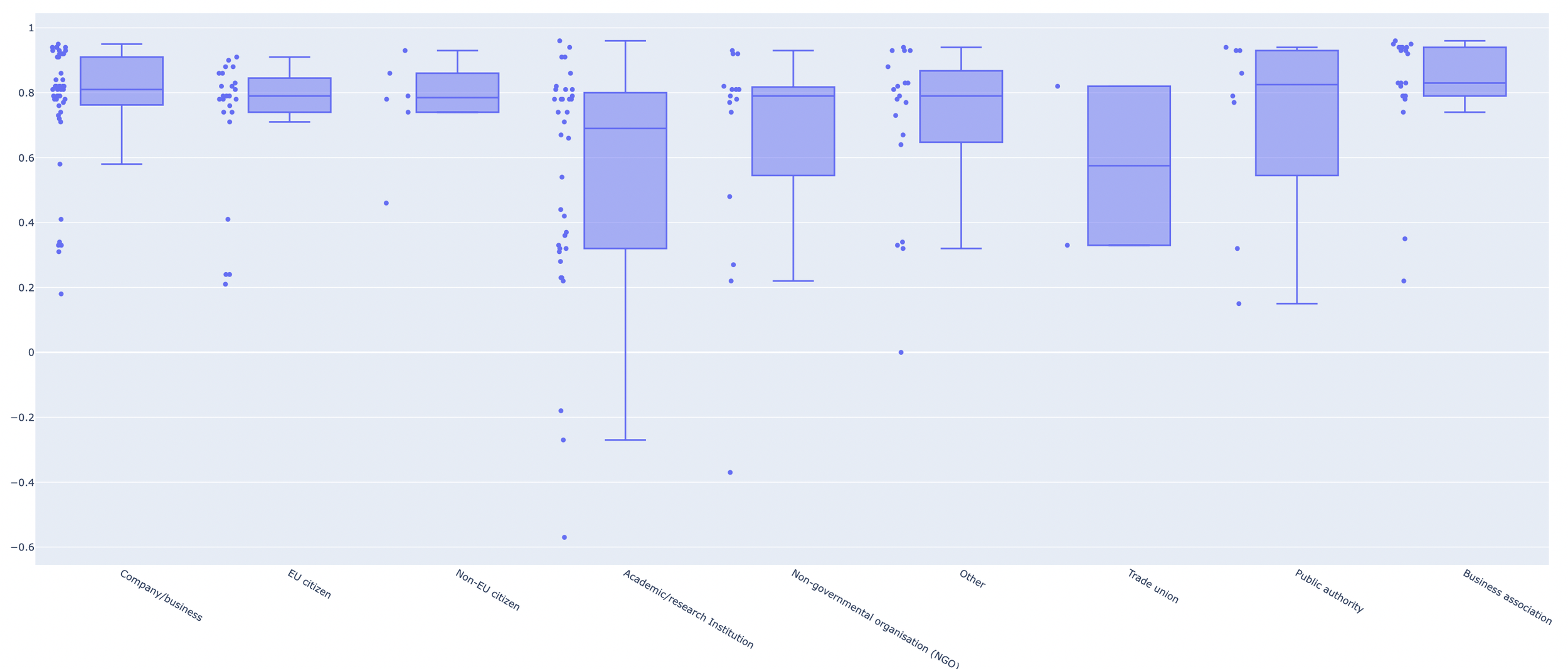
We trained a second model to measure how closely each consultation response aligned with a baseline statement saying that, in the forthcoming initiatives, commercial deployment should be prioritised over additional research investment (adapted slightly for each sector). We then grouped the results by stakeholder type.
Looking at the box plots below, industry does indeed consistently place slightly greater emphasis on deployment than the research community, but, across all stakeholder groups, organisation type explained very little of the overall variation in alignment with our baseline position (only about 7-8%). It’s fair to say that in biotechnology, quantum and cleantech, improving deployment of innovation is a shared priority across the ecosystems. (4) (5)
The Commission may not yet have recognised how systemic an issue deployment is. That’s hardly surprising, given its vertically siloed architecture and the fact that the main bottleneck to deployment differs between sectors. (6) The risk is that when the Commission does recognise this cross-cutting problem, its instinct will be to create a cross-cutting response: a Commissioner for Deployment, heading up a Deployment Task Force in DG DEPLOY.
***
This hints at a broader issue with how the Commission develops strategies. I remember one official saying with pride that they had convened representatives from over 20 DGs for the task force drafting their strategy. The result is that strategies become Christmas trees, with everyone hanging their own measures on the branches. They also become cross-references. Strategy A references Strategy B, which references Strategy C, which references…
This is a great way to optimise for coalition management and internal buy-in, but not so useful for tackling Europe’s deployment problem. It also doesn’t address that, more fundamentally, deployment isn't a policy area like transport or fisheries. It's an outcome. So rather than configuring for buy-in, strategy development should centre on identifying the single greatest constraint preventing the outcome and removing it.
And - to bring it back to the Work Programme - for that, the Commission doesn’t need to be finding more priorities, but finding a better way to prioritise.
A handier way to think about institutional prioritisation is through the Theory of Constraints, a management theory. Its central idea is that in any complex system, overall performance is determined by its biggest constraint. Improving everything else will move you some way forward, but if you're not addressing the weakest link, the performance of the whole system will always remain capped.
This is the logic the Commission should apply to its Work Programme. (7) We do not need a host of new flagship initiatives. Nor should success be measured by how many proposals it tables or withdraws. Success should be measured by the Commission’s ability (and speed) in identifying the single, white-hot constraint the stakeholders closest to the problem believe is preventing their technology from reaching the market, honing that diagnosis, removing the constraint, confirming that doing so has materially improved deployment, and moving on to the next one. Then repeating the process.
I do believe the Commission has done a decent job identifying some of Europe's strategic technologies. Now it needs to become equally good at identifying the single greatest constraint preventing those technologies from reaching the market.
***
(1) I say this as a consultant who has manually reviewed more Commission public consultation responses than I'd care to remember.
(2) By deployment, I mean the process of getting a technology out of the lab and into widespread commercial use. The constraint on that process will differ by sector: it might be capital, infrastructure, procurement, standards, regulation or something else entirely.
(3) Indeed, many of the other priorities, like capital, standards, procurement and skills, are better understood as enablers of deployment, rather than ends in themselves.
(4) Across the consultations, stakeholder type explained only 7-8% of the variation in deployment alignment scores (η² = 0.081; ω² = 0.067).
(5) Yes, we can run your sector’s Call for Evidence through both models, and yes, the Commission does find it interesting when we share such analyses with them.
(6) It’s also why I am bullish on generalist public affairs consultants - if you’re comfortable across different sectors, it becomes much easier to spot patterns and apply insights across domains.
(7) We take for granted that the competitiveness agenda is still the organising principle in the EU, and competitiveness is all for nothing if it never gets out of the lab and onto the market.